
Features
Accounting and the ledger
Double-entry books that refuse to go out of balance, with every report reading the same journal lines.
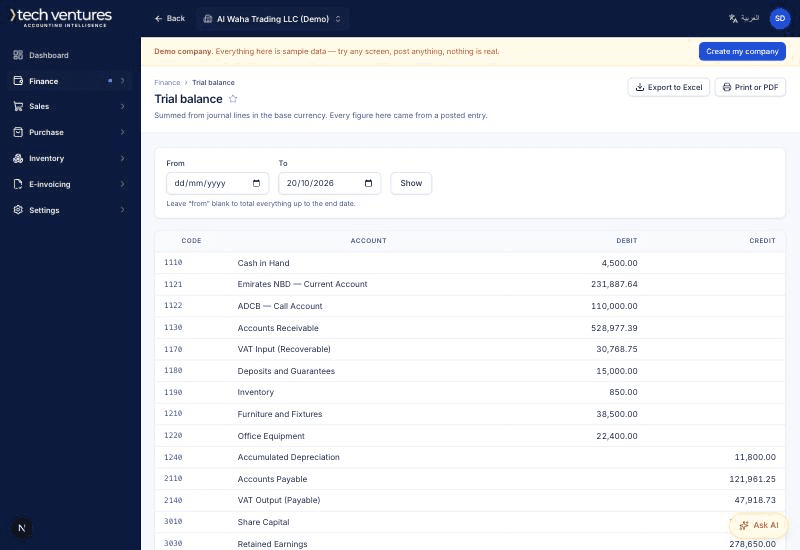
Every financial fact in the system is a journal entry whose lines sum to zero in the base currency. Documents produce entries; reports read entries. There is no second store of figures to fall out of step with the first, which is why the trial balance always balances and why any figure in any report can be opened down to the entries behind it.
uae-einvoicing.com
In this area
- A UAE chart of accounts on day one — assets, liabilities, equity, income and expenses, with the VAT, receivable, payable, inventory and retained-earnings accounts already identified by role.
- Journal vouchers with cost centres and projects per line, and a running balance check that will not let an unbalanced entry post.
- Posting locks the document and the entry. Corrections are reversals, which leave both the original and the correction in the ledger — the trail an auditor expects.
- Multi-currency with daily Central Bank rates, and realised exchange gain or loss worked out at settlement rather than at a period end.
- Monthly periods an admin closes, and a year-end routine that posts the profit to retained earnings. Nothing posts into a closed period, which is the only reliable way to stop a late entry changing a filed return.
- Trial balance, profit and loss, balance sheet, cash flow, general ledger, day book, and ledgers by cost centre and project — all with a comparison period and all drillable.